
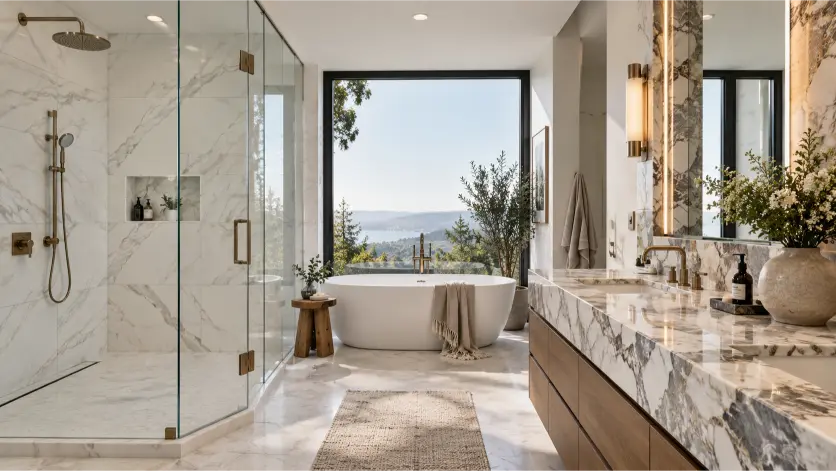
Article Summary
Marble-look porcelain tile and real marble can create a similar elegant look, but they behave differently in daily use. Porcelain is usually easier for busy floors, wet rooms and low-maintenance homes. Real marble offers natural variation that manufactured tile cannot fully duplicate, but it needs more careful cleaning and may benefit from sealing. This guide compares both options for bathrooms, kitchens and main living areas.
Table of Contents
- Article Summary
- Table of Contents
- What Is Marble-Look Porcelain Tile?
- What Is Real Marble Tile?
- Marble-Look Porcelain vs. Real Marble: Quick Comparison
- Which One Is More Durable?
- Which Is Easier to Maintain?
- Does Real Marble Need to Be Sealed?
- Which Is Better for Bathrooms and Showers?
- Which Is Better for Kitchen Floors and Backsplashes?
- Which Is Better for High-Traffic Areas?
- Which One Looks More Authentic?
- Cost: Marble-Look Porcelain vs. Real Marble
- Which Is Better for Homes With Kids and Pets?
- When Real Marble Is Worth Choosing
- When Marble-Look Porcelain Is the Better Choice
- How to Compare Both Options in Person
- FAQs About Marble-Look Porcelain vs. Real Marble
What Is Marble-Look Porcelain Tile?
Marble-look porcelain is porcelain tile designed to reproduce the colour, veining and finish of natural marble. Because the pattern is manufactured, it can give homeowners a more controlled look while keeping the practical benefits of porcelain.
The Tile Council of North America defines porcelain tile as tile with water absorption of 0.5% or less. See the TCNA explanation of porcelain tile for the technical definition.
RSC carries porcelain tiles in many sizes and finishes. Verified marble-look examples include KA36201 Calacatta White Matt and the polished Crystal Calacatta 16×32 porcelain tile.
What Is Real Marble Tile?
Real marble is natural stone cut from quarried material. Each piece has its own colour movement, veins and markings. That natural variation is a major part of its appeal and cannot repeat in the same way as a printed porcelain pattern.
Marble is also more sensitive to certain cleaners, acids and staining agents. Browse RSC’s marble tile collection and confirm the care requirements for the specific stone before ordering.
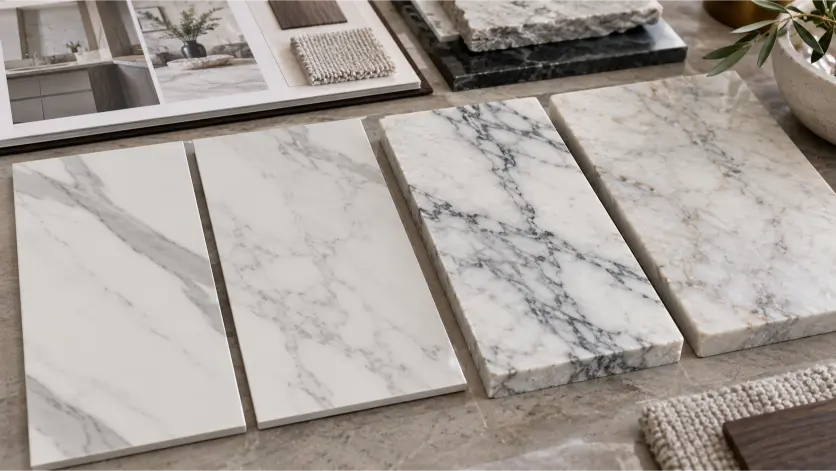
Marble-Look Porcelain vs. Real Marble: Quick Comparison
| Feature | Marble-Look Porcelain | Real Marble |
|---|---|---|
| Appearance | Controlled marble-inspired patterns | Unique natural veining |
| Water absorption | Very low for true porcelain | Varies by stone |
| Maintenance | Generally straightforward | Needs stone-safe care |
| Sealing | No natural-stone sealer needed for the tile | May benefit from sealing |
| Busy floors | Often practical when floor-rated | Works with more attentive care |
Which One Is More Durable?
For everyday residential wear, porcelain is usually more forgiving. It is dense, low-absorption and available in products rated for floors and high-traffic areas. It works well where spills, shoes and regular cleaning are part of daily life.
Marble is durable, but its surface can scratch or etch more easily than porcelain. The exact result depends on the stone, finish and maintenance. Always check the intended application for the specific tile.
Which Is Easier to Maintain?
Marble-look porcelain usually requires less specialized care. Finish still matters: polished surfaces may show streaks or footprints more readily than matte ones. RSC’s guide to matte vs. polished porcelain tile explains where each finish tends to work best.
Real marble should be cleaned with stone-safe products. The Natural Stone Institute notes that acids such as vinegar or lemon can dull or etch calcareous stones. See its natural stone care guidance.
Does Real Marble Need to Be Sealed?
Often, but not automatically in every case. The Natural Stone Institute explains that impregnating sealers can make some stone more stain resistant, but they do not make it stain proof. Whether marble should be sealed depends on the stone, finish, location and sealer guidance.
Porcelain tile itself does not need the same natural-stone sealing, although grout may have separate maintenance needs.
Which Is Better for Bathrooms and Showers?
Porcelain is often the simpler bathroom choice because of its low water absorption and wide range of floor- and wall-rated products. Marble-look porcelain can create the character of stone without the same stone-specific care.
Real marble can also work in bathrooms when the stone, finish, waterproofing system and maintenance plan are appropriate. For wet-area details, see RSC’s guides to the best tile for shower walls and the best porcelain tile for shower floors.
Which Is Better for Kitchen Floors and Backsplashes?
For a busy kitchen floor, marble-look porcelain is usually easier to live with. Spills, grit and frequent traffic make durability and cleaning important. A floor-rated porcelain tile can give you the marble look with less concern about etching from acidic spills.
On a backsplash, both materials can work because foot traffic is not an issue. If size is part of your decision, RSC’s 12×24 vs. 24×48 porcelain tile guide covers layout considerations.
Which Is Better for High-Traffic Areas?
Marble-look porcelain is generally the practical choice for entrances, hallways, kitchens and open main floors. It handles frequent cleaning well and is less sensitive to common household acids. Choose a product rated for the intended floor application.
Real marble can be used in high-traffic homes, but owners should be comfortable with more attentive care and with some patina developing over time.
Which One Looks More Authentic?
Real marble is the authentic natural material, so every piece has genuine variation. Modern porcelain printing can still be very convincing. Better collections use multiple faces so repeated patterns are less obvious.
When comparing samples, look at several pieces together. Check how often the veining repeats, how the pattern crosses grout joints and whether the finish suits the room.
Cost: Marble-Look Porcelain vs. Real Marble
Real marble often carries higher material and installation costs, but totals vary by stone, size, finish, availability and project complexity. Porcelain also spans a broad price range.
Compare the full project rather than only price per tile: material, waste allowance, setting materials, labour, sealing if recommended and long-term care. RSC can help you compare current options without relying on outdated online price assumptions.
Which Is Better for Homes With Kids and Pets?
For households with children or pets, marble-look porcelain is usually the lower-maintenance choice. Spills, paw prints and frequent cleaning are easier to manage when the surface is not sensitive to acidic household messes. A matte finish may also hide everyday marks better than a high-gloss surface.
Real marble can still work well on walls, backsplashes or lower-traffic feature areas.
When Real Marble Is Worth Choosing
Choose real marble when the natural material itself is part of the design goal. It makes sense when you value one-of-a-kind veining, are comfortable with stone-safe cleaning and accept that the surface may develop character over time.
It can be especially effective for a feature wall, backsplash, powder room or carefully planned bathroom where the stone will be seen up close.
When Marble-Look Porcelain Is the Better Choice
Choose marble-look porcelain when you want the visual direction of marble with easier day-to-day ownership. It is often well suited to busy kitchens, family bathrooms, entryways and larger floor areas. It also gives you more control over colour and pattern from tile to tile.
Compare sizes, finishes and applications in RSC’s porcelain tile collection.
How to Compare Both Options in Person
Photos do not show everything. Vein depth, reflection, texture and natural variation are easier to judge in person. Bring cabinet, countertop or paint samples if you have them, and compare several tiles together rather than one sample alone.
At the RSC Oakville showroom, you can compare porcelain and marble options side by side and discuss where each material will be installed. RSC Kitchen Bath & Flooring is at 1042 Speers Rd in Oakville.
Once you have a short list, request a free quote so the material and installation requirements can be reviewed together.
FAQs About Marble-Look Porcelain vs. Real Marble
Can marble-look porcelain really look like natural marble?
Yes. Modern porcelain can reproduce marble colours and veining closely. Real marble still has natural variation that does not repeat.
Is porcelain better than marble for a shower?
Porcelain is often easier to maintain, but the correct choice depends on the specific product, finish and installation. Real marble can also work when it is suitable for the application and cared for correctly.
Does marble-look porcelain stain?
Porcelain has very low water absorption, but grout and surface finishes still need appropriate cleaning. Follow the manufacturer’s instructions for the exact product.
Does real marble always need sealing?
No. Some marble benefits from an impregnating sealer, while other installations may not require one. Ask the supplier or sealer manufacturer for guidance based on the specific stone and location.
Which option is better for resale value?
There is no universal answer. Some buyers value natural stone; others prioritize low maintenance. A well-chosen, properly installed tile that suits the home is usually more important than selecting a material only for resale expectations.