
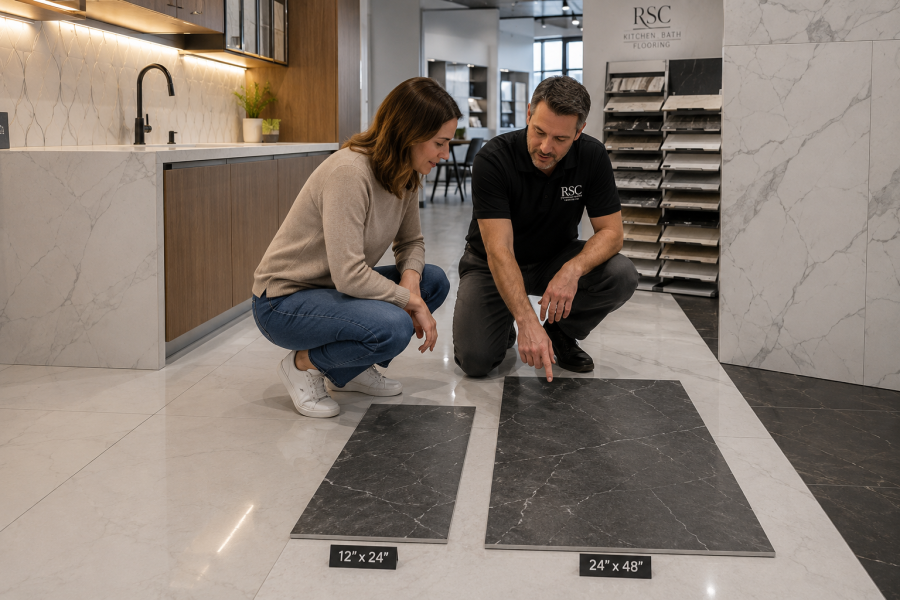
12×24 vs. 24×48 Porcelain Tile: Quick Comparison
Both sizes fall into the large-format tile category and are available in many stone-look, marble-look and contemporary porcelain designs.
| Feature | 12×24 Porcelain Tile | 24×48 Porcelain Tile |
|---|---|---|
| Overall look | Modern and versatile | Seamless and dramatic |
| Grout lines | More | Fewer |
| Small rooms | Excellent | Can work with careful planning |
| Large rooms | Good | Excellent |
| Cutting around fixtures | Easier | More planning required |
| Installation complexity | Moderate | Higher |
| Walls | Excellent | Excellent for feature walls and showers |
| Floors | Excellent | Excellent on properly prepared surfaces |
| Material handling | Easier | Heavier and more difficult |
| Best for | Bathrooms, kitchens, entries | Large bathrooms, open floors, feature walls |
If you are still comparing colours and finishes as well as sizes, read our guide to matte vs. polished porcelain tile before making the final decision.
Why 12×24 Porcelain Tile Is So Versatile
The 12×24 format has become a practical middle ground between traditional small tiles and oversized porcelain.
It is large enough to create a modern appearance without becoming difficult to fit around vanities, toilets, doorways and other obstacles.
RSC carries a broad selection of 12×24 porcelain tiles in different colours and stone-inspired designs.
A 12×24 tile is particularly useful for:
- Standard bathrooms
- Ensuite floors and walls
- Kitchen floors
- Entryways and mudrooms
- Laundry rooms
- Basement bathrooms
- Shower walls
It also gives installers more flexibility when room dimensions are irregular.
For homeowners who want a modern tile without committing to an oversized format, 12×24 is usually the easier starting point.
Why Choose 24×48 Porcelain Tile?
A 24×48 tile covers four times the surface area of a 12×24 tile.
That means fewer individual tiles and, most importantly from a design perspective, fewer grout lines.
The result can be a cleaner and more continuous surface.
Large-format porcelain is particularly effective with marble-look, concrete-look and natural-stone-inspired designs because larger pieces allow the pattern and veining to become a stronger visual feature.
RSC’s current porcelain tile collection includes several 24×48 options, such as Camellia Winter Grey Honed,
Rockwood Plain Matt and Sterling Grey Matt.
24×48 porcelain works especially well for:
- Large ensuite bathrooms
- Full-height shower walls
- Open-concept kitchens
- Main-floor living areas
- Large entryways
- Fireplace walls
- Feature walls
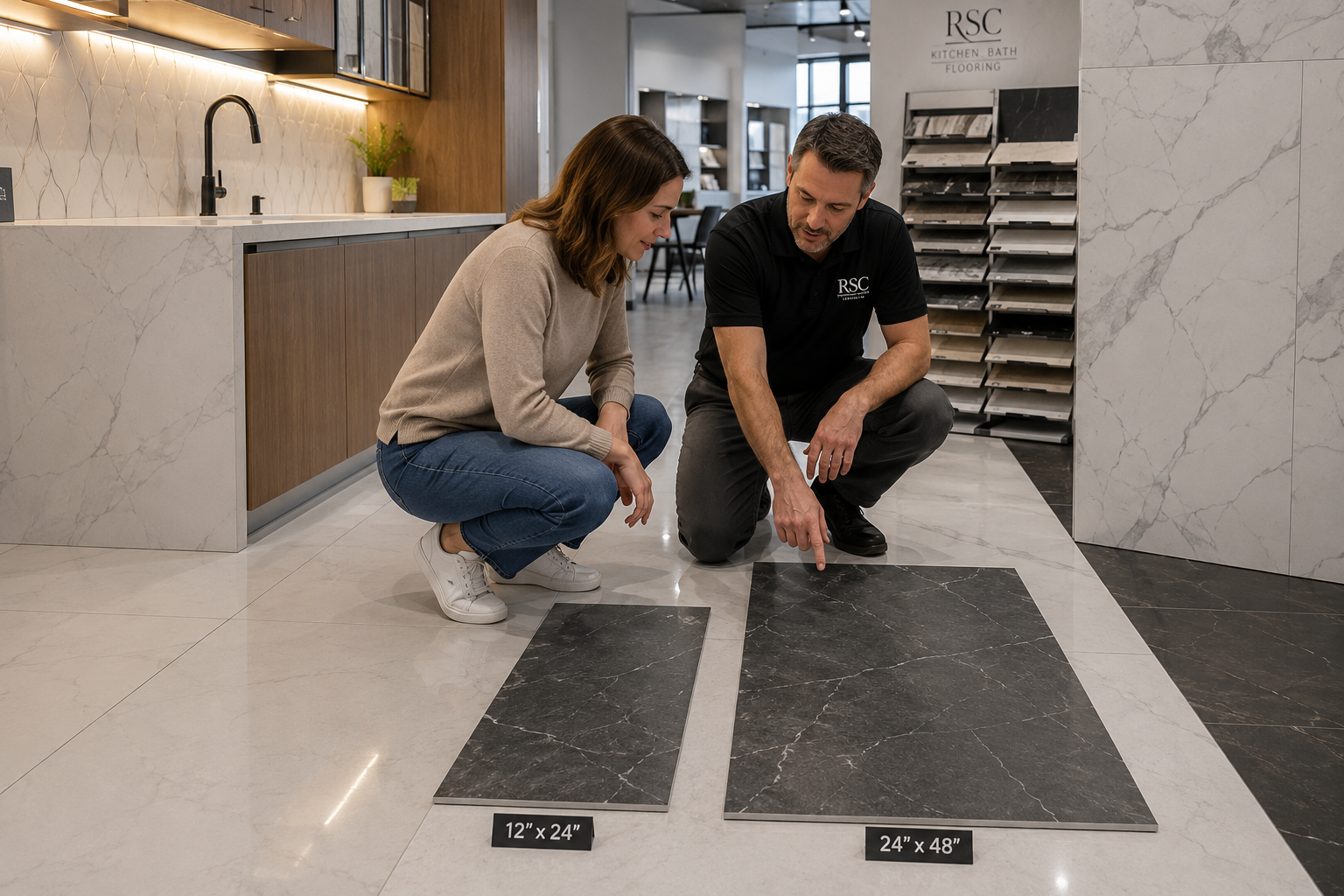
The goal is usually a clean, uninterrupted visual surface rather than a noticeable tile pattern.
12×24 or 24×48 for a Small Bathroom?
A common design rule says that small rooms need small tiles.
That is not necessarily true.
Large-format tile can work very well in a small bathroom because fewer grout lines can make the surfaces feel less busy.
The real question is how well the tile fits the room.
Choose 12×24 when:
- The bathroom has several corners or obstacles
- The floor area is narrow
- There are many cuts around a toilet or vanity
- You want more layout flexibility
- You want the same tile on both floors and walls
Consider 24×48 when:
- You want a very clean, spa-like appearance
- The wall dimensions allow large pieces with attractive cuts
- You want fewer grout lines
- The installer can plan the layout before cutting
For many standard Oakville bathrooms, 12×24 is the safer and more flexible choice, while 24×48 can create a stronger luxury look when the room dimensions and installation allow it.
Our broader tile sizes and patterns guide covers additional sizes and layout ideas if neither format fits your project.
What About Shower Walls?
Both sizes work extremely well on shower walls.
A 12×24 tile gives you more layout choices. It can be installed horizontally, vertically or in a stacked pattern.
A vertical layout can help emphasize height, while a horizontal layout can visually widen the shower.
With 24×48 tile, the look changes significantly.
A standard shower wall may need only a few large pieces, which creates a nearly continuous surface with very little grout. Marble-look porcelain is especially effective in this format because the larger tile allows more of the veining to remain visible.
The trade-off is installation complexity.
Large pieces need accurate measuring, careful handling and properly prepared walls.
Which Size Is Better for Kitchen Floors?
For a standard kitchen, 12×24 porcelain remains a very practical choice.
It works around:
- Islands
- Cabinet runs
- Doorways
- Pantry walls
- Floor transitions
It also gives the installer more options for centring the layout and avoiding awkward narrow cuts. In a large open-concept kitchen, however, 24×48 tile can make a strong visual impact. Fewer grout lines can help connect the kitchen, dining area and surrounding spaces into one continuous floor.
If you are renovating an open main floor, first determine where tile will transition to hardwood, luxury vinyl or another surface. Tile size should be selected as part of the entire floor plan rather than room by room.
Entryways and Mudrooms: Which Size Works Better?
Both formats can work, but the shape of the room matters.
A 12×24 tile is often easier to fit into smaller entryways where closets, stairs and door openings break up the floor. A large foyer with a simple rectangular layout may be better suited to 24×48. For either size, finish matters as much as dimensions. Entryways deal with wet shoes, snow and everyday dirt, so the specific tile should be suitable for floor use.
You can compare matte porcelain tile options if the project involves a busy entryway or mudroom.
Do Larger Tiles Really Mean Less Grout?
Yes.
One of the main reasons homeowners move from 12×24 to 24×48 is to reduce the visual amount of grout.
Fewer grout lines can:
- Make a room look cleaner
- Allow marble or stone patterns to stand out
- Create better visual continuity
- Reduce the grid-like appearance of the floor or wall
However, fewer grout joints do not mean that grout can be eliminated completely.
Joint width depends on the tile, its dimensional variation, the layout and the manufacturer’s installation requirements.
The Tile Council of North America also notes that grout joints and tile flatness need to be considered as part of a proper installation.
Large-Format Tile Requires Better Surface Preparation
This is where the difference between the two sizes becomes important.
Both 12×24 and 24×48 tiles are considered large-format installations, but the bigger the tile becomes, the less forgiving the installation is. A small uneven area in a wall or floor can become much more noticeable across a 48-inch tile.
Industry installation guidance places particular importance on substrate flatness, grout-joint planning and installation methods for large-format tile. The current TCNA Handbook for Ceramic, Glass, and Stone Tile Installation specifically covers substrate flatness requirements, grout-joint sizes and installation standards.
With 24×48 tile, installers may need additional:
- Floor or wall preparation
- Levelling
- Mortar coverage
- Tile handling equipment
- Cutting equipment
- Layout planning
This is one reason the largest tile is not automatically the best tile.
The finished result depends heavily on the condition of the surface beneath it.
Does 24×48 Tile Cost More to Install?
Not necessarily in every project, but large-format installations can involve additional labour.
Although fewer tiles are installed, each piece is larger and heavier. Cutting, positioning and achieving consistent alignment can require more time and specialized tools. Surface preparation can also become a larger part of the job. For that reason, compare the complete installation cost rather than the price per square foot of the tile alone.
If you are considering 24×48 porcelain for a large bathroom, floor or feature wall, having the substrate evaluated before purchasing the material can help avoid surprises later.
RSC provides professional tile installation and renovation support for homeowners who want help selecting and installing large-format tile.
How to Choose Between 12×24 and 24×48
Use these five questions.
1. How large is the uninterrupted surface?
A large open wall or floor gives 24×48 tile room to work.
A floor broken up by cabinets, fixtures and doorways may favour 12×24.
2. How important are minimal grout lines?
If a seamless look is your main goal, 24×48 has a clear advantage.
3. How flat is the existing surface?
Large tiles become less forgiving as size increases.
4. What look are you trying to create?
12×24 creates a clean contemporary finish.
24×48 creates a stronger architectural and luxury appearance.
5. Have you seen the tile at full size?
A small sample does not show how a large-format pattern will look across an entire piece.
Seeing full tiles in person can make the decision much easier.
Final Recommendation
There is no universal winner in the 12×24 vs. 24×48 porcelain tile comparison.
For most bathrooms, kitchens, entryways and medium-sized rooms, 12×24 porcelain tile offers the best balance of modern style, layout flexibility and installation practicality. For larger rooms, open floors, shower walls and feature areas, 24×48 porcelain tile creates fewer grout lines and a more seamless, high-end appearance.
The best decision should consider the room dimensions, tile pattern, surface condition, installation requirements and the way the tiles will be cut at walls and fixtures.
Visit RSC Kitchen Bath & Flooring at 1042 Speers Road in Oakville to compare full-size porcelain tile options, colours and finishes before choosing.
Browse the complete porcelain tile collection or request a free quote for your project.
FAQs About 12×24 vs. 24×48 Porcelain Tile
Do 24×48 tiles make a small bathroom look bigger?
They can. Fewer grout lines often create a more continuous surface, but the layout must work with the room dimensions. Poorly positioned cuts can reduce the effect.
Is 12×24 tile considered large format?
Yes. Tile-industry guidance treats tiles with an edge greater than 15 inches as large format, so 12×24 falls within that category.
Is 24×48 porcelain good for shower walls?
Yes, when the specific tile is approved for wall installation and the wall is properly prepared. Large pieces can create a clean look with very few grout joints.
Is 24×48 tile harder to install than 12×24?
Generally, yes. Larger pieces are heavier, harder to cut and require greater attention to substrate flatness and mortar coverage.
Which size is easier to use around bathroom fixtures?
12×24 usually provides more layout flexibility around toilets, vanities, niches and other obstacles.
Can I use 12×24 and 24×48 tile in the same bathroom?
Yes. For example, you could use 12×24 on the floor and 24×48 on shower walls, provided the colours, patterns and finishes work together.